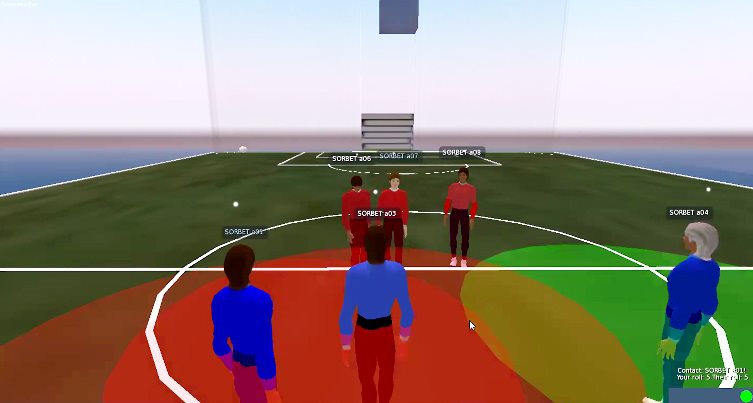
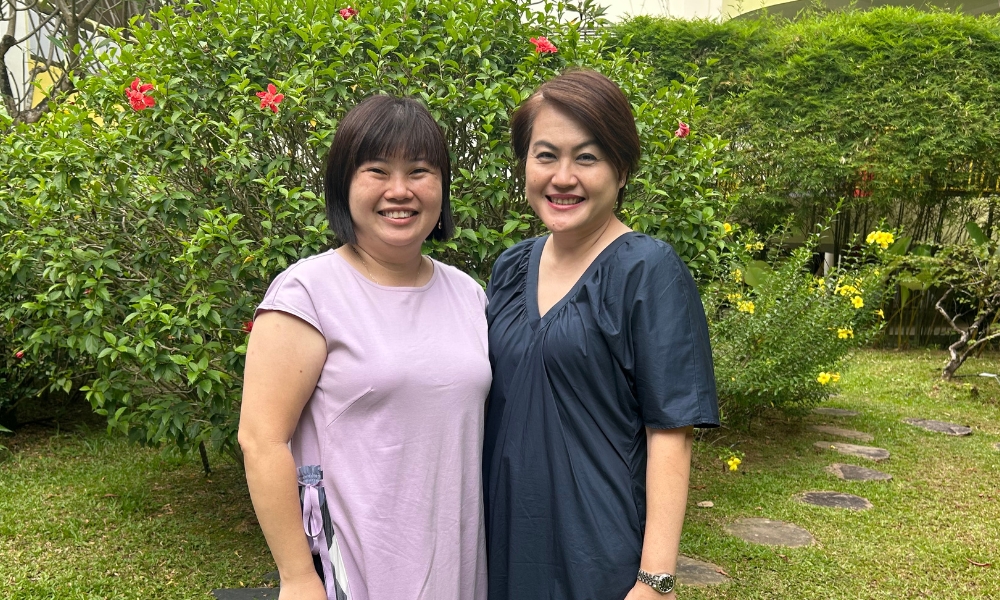
In Cedar Girls’ Secondary School, two students, Aurelia Azifa Chelfannisa and Natalie Lee, used the SORBET Project to conduct a social experiment on their classmates to observe people’s behaviour towards social distancing, and the impact of their actions on their health and those around them. The participants of the experiment were first asked to go through the SORBET Project simulation without having been informed about the presence of a virus in the virtual environment. Next, the participants were told that there was a virus in the simulation and asked to repeat the simulation, and the girls administering the experiment observed the corresponding changes in their behaviour.
What have you learnt from the SORBET Project and the social experiment you conducted with your classmates?
Aurelia: This project has been an exciting experience for me. We were introduced to the SORBET Project to aid us in our research project. We conducted activities in the virtual space with groups of participants who would get “infected” if they got too close to one another, just like in real life. This SORBET environment has been a suitable replacement of a real life setting and has allowed us to see how people would behave in their daily lives. By observing their interactions, we were able to have a better understanding of how people in society would also behave in the community. Those who are more reckless with social distancing measures ended up getting infected in the simulation and I was able to draw links to their behavior in real life too. Overall, the SORBET Project has given me a platform to better understand and be more observant of people’s behavior.
Natalie: There were many learning opportunities which came with the SORBET Project. Since we had no experience in conducting social experiments, we had no idea what to expect. In fact, the first run of our activity failed. However, as the saying goes: “Failure is the key to success”. So, we learnt from the failure and moved on. Looking into the data we collected from the second round of the social experiment, we were able to analyse social behavior among our classmates and the reasoning behind such behaviors.
How do you think the SORBET Project can benefit you and your classmates?
Aurelia: The SORBET Project was an interesting and new software that I have never used before and has been a fun experience for me. It was a suitable software to act as an environment to simulate real life and for participants to play around with. We were also able to manipulate some of the settings of the SORBET environment to suit our activities. This allowed us to observe the participants’ behaviors and how they reacted to different situations. It is a very flexible and comfortable software to use. This project has also taught us how to observe our surroundings at a larger scale too. It has made me realize that these different behaviors can also be seen around us in real life. I hope that my classmates and the other participants were able to do so too, to be more wary of the people around them and their actions. I look forward to using this software again in the future for other projects.
Natalie: The SORBET Project provides a visualization of how diseases can spread within a community, depending on different variables. This allows for players to have a deeper understanding on the importance of safe distancing. As our classmates could explore and interact with the simulation environment personally, they were able to observe how their own actions directly affected the results – the number of infected individuals. This hands-on experience also encourages players to apply information they have obtained from real life situations to the simulation and vice versa. As for me and my teammate, the project allowed us to think like researchers and gain some insight into the world of qualitative research.
Aurelia Azifa Chelfannisa and Natalie Lee
Cedar Girls’ Secondary School