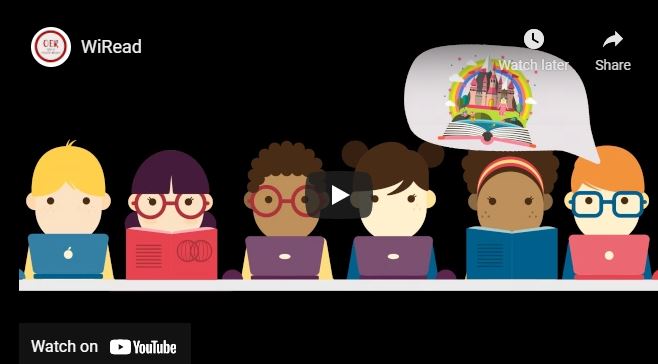
Looking to inspire your students to think critically, communicate effectively, and collaborate to build knowledge? Look no further.
WiREAD: Reading Collaboratively With Critical Lenses
 How Can WiREAD Help Your Students?
 Why WiREAD?
As teachers, we want our students to be able to read a given text critically, and be able to articulate their understanding of the text. WiREAD seeks to nurture these abilities through a web-based environment with simple tools for learners to guide their reading and empower discussions.
To scaffold students to read a text critically, WiREAD provides students with a set of critical lenses adapted from Paul’s Wheel of Reasoning. To enable students to use these critical lenses in a discussion of the text, WiREAD provides a set of comment types.
WiREAD was successfully piloted in one mainstream secondary school over two years, involving 1 HOD, 6 teachers and 379 students using 20 multimodal texts. Teacher participants observed an improvement in the quality of students’ critical discussions of the multimodal texts. Students’ performance in post-tests also showed a significant improvement in their critical reading fluency performance.
 How Does WiREAD Work?
Using two guiding structures, critical lenses and comment types, WiREAD scaffolds students to first read a given text critically, and then use the critical lenses in an engaging discussion involving various comment types.
Step 1: Critical reading
To read a given text, students apply one or more critical lenses, a set of perspectives for thinking adapted from Paul’s Wheel of Reasoning.
Wearing the critical lens(es), students consider the following in analysing the text:
- message
- purpose
- audience
- assumption
- viewpoint
- inference
- impact
Step 2: Collaborative discussion
Students use the comment types as a guide to discuss the given text. The varied comment types guide students to use the critical lenses in different ways: to ideate, justify, validate, challenge or clarify.
For example, a student may challenge (comment type) a peer’s analysis of the audience (critical lens). A student may also use evidence to justify (comment type) his/her analysis of the author’s viewpoint (critical lens).
Step 3: Formative assessment using the online platform
Students and teachers use “My Learning Dashboard” to analyse the quality of their discussion, enabling them to modify their behaviour to achieve desired outcomes.
Evidence From WiREAD Research
- Observation: Teacher participants observed an improvement in the quality of students’ critical discussions of the multimodal texts.
- Performance in critical reading tests (pre- and post- tests): Comparing scores before and at the end of the project, the WiREAD group showed a slightly significant improvement in their critical reading fluency performance, compared to the control group who saw a slight decline in performance.
 How Can Teachers Get Started?
Without the WiREAD Programme
With the WiREAD Programme
- Contact Knowledge Mobilisation Unit (KMb@OER) at oerkmob@nie.edu.sg, if you are interested to use the online WiREAD platform with your students.
 Related Links
- ReED Vol 17, 2015 “We Read with WiREAD”[PDF]
 Further Readings
Research Projects
 Research Team
To learn more about WiREAD, please contact Knowledge Mobilisation Unit (KMb@OER) at oerkmob@nie.edu.sg
Co-Principal Investigator (Lead Research Investigator)
Principal Investigator
Co-Principal Investigator
MOE Partners
Research Assistant
Software Engineer
Acknowledgments
This research on WiREAD was funded by Singapore National Research Foundation (NRF) under the eduLab Programme (NRF2013-EDU001-EL019) and administered by National Institute of Education (NIE), Nanyang Technological University, Singapore. Any opinions, findings, and conclusions or recommendations expressed in this material are those of the author(s) and do not necessarily reflect the views of the Singapore NRF and NIE.
This knowledge resource was written by Dr Jeanne Marie Ho and Ms Monica Ong; updated by Ms Monica Lim and Mr Jared Martens Wong on 4 January 2022.