When the whole is bigger than the sum of its parts.
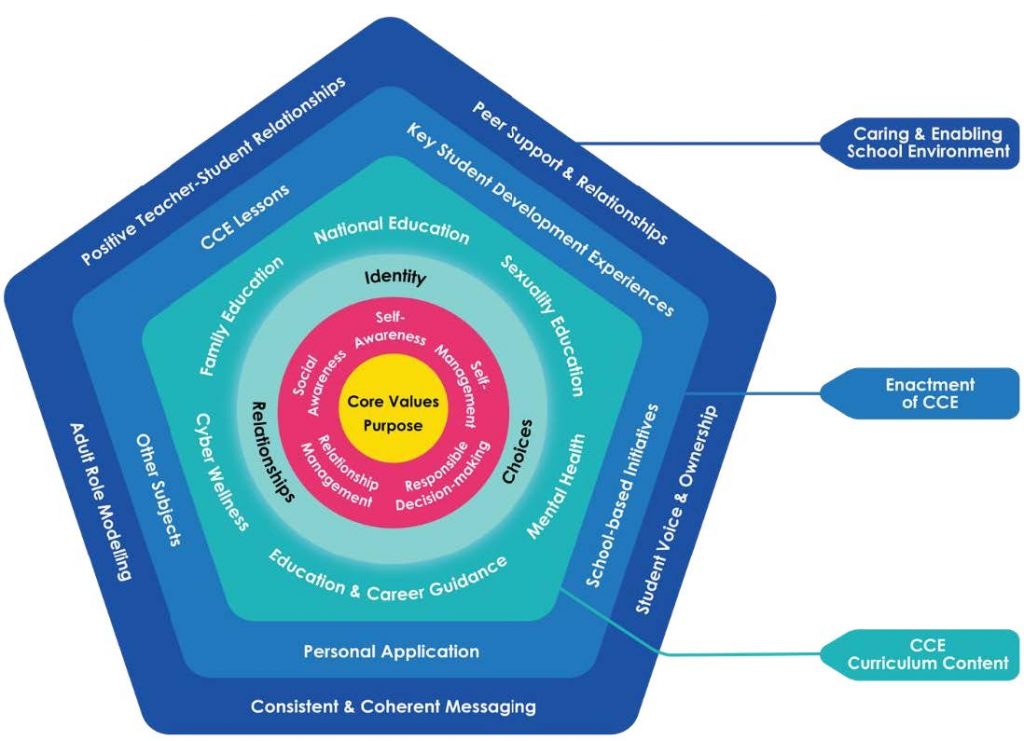
When my colleagues1 were conceptualizing the set-up of the Singapore Centre for Character and Citizenship Education (SCCCE) at the National Institute of Education, we first had to unpack the concept of CCE. In essence, this is what I learned from them: CCE is not a single “discipline” in the traditional sense; CCE 2021 was a brave attempt to draw connections between the concepts of values, character, citizenship dispositions, SE competencies, well-being and resilience and future-readiness; many of which have both philosophical and psycho-social dimensions.
In a secular state like Singapore that is culturally and socially diverse and at the cross-roads of the East and the West, there is no single philosophical perspective or psychological theory that can fully address the various dimensions of child and youth development.
As such, the learning and developmental needs of the child both as an individual and as a member of society are fundamental in our design of the CCE curriculum. This involves seeing character and citizenship education as two sides of the same coin; nurturing good character to developing individuals and citizens who are willing to apply sound values, social and emotional as well as civic competencies as they strive to understand themselves, the community they live in and its needs, and what they can do to address those needs.
Hence, CCE is not a single discipline in the traditional sense, but a distinct cross-disciplinary field of knowledge that focuses on synergizing key aspects of child and youth development, character development, SE well-being, and citizenship dispositions to inform how we can better facilitate the holistic development of our children.
There are so many questions the SCCCE can explore and facilitate conversations around:
- In today’s VUCA (volatility, uncertainty, complexity and ambiguity) world that is threatened by geopolitics and partisan interests, what are the values that we hold dear, and which hold us together, not only as a nation, but as a member of the global community?
- In a world of woke culture and social justice where our young clamour to be heard, how do we guide them to build trust and understanding, to navigate differences and exercise their agency in a constructive way?
- Knowing that they will face the demands and stressors of modern-day life, how can our young continually build up their internal reservoir of purpose and resilience, and thrive?
SCCCE has the potential of developing CCE as a cross-disciplinary field of study. In my mind, it probably is the first in the world. The setting up of SCCCE reinforces our intentionality to strengthen character, well-being, and citizenship dispositions in our education endeavours for all our learners. Our aspiration is for the SCCCE to strengthen the nexus of research, policy and practice, where its research can inform the work of policymakers, curriculum designers, school leaders and teachers.
And of course, true to the purpose of NIE, the SCCCE will be a hub for teachers’ professional development in CCE whether you are a student-teacher just starting on your journey or a seasoned educator.
What is our end-goal for CCE? How can teachers find out how students have learned and developed through CCE2021?
“Assessment in CCE” is not an easy concept. Similar to how we grow and mature over time, the development of character and citizenship dispositions of our students will also take time to reach various milestones. As our students grow, we as educators can help them in several ways:
- How are we enabling students to make sense of their learning experiences? Have we given time to dialogue with their peers? Are they ready to reflect on their own or do they need some scaffolding?
- How are we enabling students to gain a better sense of their own growth and progress? Is it through self-assessment, peer feedback or teacher advice? Probably a combination, depending on the age of your students.
- As they become better at this, how do we nudge them to stretch for a higher goal? So that beyond the schooling years, they will have the resilience and drive to keep growing and learning to become their best selves in life.
Indeed, our founding Prime Minister Mr Lee Kuan Yew said it very well back in 1979:
“The litmus test of a good education is whether it nurtures citizens who can live, work, contend and co-operate in a civilized way. Is he loyal and patriotic? Is he, when the need arises, a good soldier, ready to defend his country, and so protect his wife and children and his fellow citizens? Is he filial, respectful to his elders, law-abiding, humane and responsible? Does he take care of his wife and children, and his parents? Is he a good neighbour and a trust-worthy friend? Is he tolerant of Singaporeans of different races and religions? Is he clean, neat, punctual and well-mannered?”
The end-goal that many of us educators want for our students is for them to develop a sense of purpose in life, to discover how their strengths, talents and interests can be meaningfully applied, be it in the family, community, nation and beyond.